Upgrade to Premium Now
Artificial intelligence has become a defining part of the sports business. Clubs, leagues, and broadcasters now compete for fan attention across every screen and platform, and data sits at the center of that competition. The Stats Perform 2026 Sports Fan Engagement, Monetisation and AI Trends Report shows that 81 percent of sports media organisations increased their use of AI in the past year.
For Niall Hendry, VP, AI Applications & Solutions at Stats Perform, the change is less about adopting a new technology and more about using it to connect data, storytelling, and value. Speaking to FBIN, he explains how AI helps transform raw statistics into experiences that feel emotional, personal, and engaging.
By Joachim Stelmach
A race for the eyeballs
“Fans want answers now,” Hendry says. “We exist in a race for the eyeballs.”
Audiences expect instant information, and they expect it everywhere. “It’s not enough to do something great for one game,” he explains. “You need to deliver the same experience for every league, every match, every audience.”
This demand for scale defines Stats Perform’s work with rights holders. Hendry’s team integrates AI across a range of products, turning advanced metrics, live data, and predictive insights into tools that help media and clubs reach fans faster. “The idea is simple,” he says. “Create more content, faster, and make it meaningful for the fan.”
Turning data into stories
Two-thirds of people process information visually, Hendry notes. “According to studies, two-thirds of people are visual learners,” he says. “There is a lot of data out there, but as you’ll see across various mediums, whether it’s broadcast, social media, or in applications themselves, visualisation of data is key to be able to understand it, particularly when there are a lot of numbers and for storytelling.”
He points to examples of organisations that use visualisation to make complex data feel intuitive. “Slavia Prague do a great job, as do Barcelona, by telling stories and engaging fans,” he says. “It leans into something that’s able to be digested that otherwise could feel quite nebulous as a concept.”
The same principle applies to broadcasters. “Canal+ do this for the UEFA Champions League in France, while Ekstraklasa Livepark do it in Poland,” he says. “Both use data to tell stories and to integrate sponsors in a natural way.”
When data is presented clearly, it benefits everyone involved. “Because you’re driving great stickiness into those bits of content, you can drive more advertising value,” Hendry explains. “When you make content more attractive, you make it easier to sponsor.”
Short form as the entry point
AI has also changed how content is produced and distributed. “We sort of exist in a race for the eyeballs,” Hendry says again, linking the shift to new consumption patterns. “What we’ve seen, particularly with response to the survey, is that organisations want to create AI-driven content to drive more content, but again, maintain that human authenticity to engage fans.”
Short-form video plays a major role in that strategy. “Eighty-one percent of respondents said that they are using, or plan to use, AI tooling to create short-form content for fan engagement because it’s the largest growing media form of consumption to engage fans,” he says. “That will continue to prevail across platforms like YouTube and TikTok.”
But short content isn’t the end of the journey. “That really is an engagement deployment strategy to then drive into longer-form content,” Hendry says. “Thirty-three percent of our respondents said that the long-form content actually then turns those initially engaged fans into more revenue-driving fans.”
He adds that short and long formats work together. “Short form builds awareness,” he says. “Long form builds value.”
Keeping the human voice
Hendry recognises that automation brings risks. “Large language models are very good at giving sometimes repeated and general answers,” he says. “But to be able to make that useful in sport, you need to apply the understanding of sport to it — and crucially, sports data — to give it the correct answer.”
For him, context is what separates generic AI from meaningful insight. “Think about rugby,” he says. “The phrase ‘carries’, ‘tackles’, ‘rucks’ don’t really translate to everyday life. Sports has its own nuance of language. By applying the nuance of language to sports AI, the context it can bring is relevant, but it also needs the data to be able to power it.”
That balance defines the company’s approach. “AI will get you so far,” Hendry says. “But what you need is the logic, the understanding, and the context of sport, the language of sport, to provide a better and more informed answer.”
Personalisation and interaction
The discussion around personalisation in sport often focuses on algorithms. Hendry believes the next step is more active. “With short-form content or stories-based image content, that will ultimately be driven by the algorithm on a platform — let’s say it’s TikTok or Instagram — and it will be served up relative to a target audience,” he says. “That’s a degree of personalisation.”
But for him, the real opportunity lies in owned platforms. “By having the customer base in your app and signing up their first-party data, you can then serve up content that they’re interested in,” he explains. “That can drive more sponsorship around those particular audiences.”
Fans are increasingly interested in interactive experiences. “Forty-eight percent of Millennials, thirty-three percent of Gen Z audiences said that live interactive content was most interesting to them,” he says. “Gamification came out at forty percent. You can see the early steps to true personalisation, which is much more interactive versus served-up personalisation, which is where we are today.”
New spaces for sponsors
That growing interaction is reshaping how sponsorship works. “In terms of what we’re hearing from the market,” Hendry says, “revenue growth from sponsorship and advertising respectively grew in interest from 32 percent to 44 percent for sponsorship, 35 percent to 42 percent for advertising.”
AI-driven content is part of that trend. “The more content you can create like that, the more reach you can gain, the more advertising or sponsorship you can associate with it,” he explains. “We’re also seeing that some customers are utilising AI as a key to sponsor things — Capgemini, for example, have been doing really good work around this with the Six Nations.”
He adds that the same logic applies across football. “Broadcasters like BBC have done a great job of deploying more of those AI-led statistics on their website,” Hendry says. “BBC actually, from deploying those statistics, saw a lagre uptake in stickiness of users on their platform, which goes to show that AI-driven and more advanced statistics do engage fans and can drive dwell time.”
For Hendry, this is evidence that AI can connect storytelling, engagement, and commercial value. “Relevant data makes content more engaging,” he says. “And engagement raises commercial value.”
Looking ahead
Hendry’s view of the future is clear: AI will make sport more interactive, more personalised, and more connected. “Fans want to explore, to ask questions, to understand what matters to them,” he says. “The way to deliver that is with the best content at scale possible, driven by data and underpinned by AI technologies.”
He believes that the next step for clubs and broadcasters is to turn technology into experience. “It needs to move beyond pure innovation into an experience that is meaningful to fans,” he says. “Technology itself isn’t the story anymore. The story is how you use it to meet fan expectations.”
A partnership built on insight
As an FBIN Partner, Stats Perform continues to explore how AI and data can shape engagement and value across the sports industry. From reliable datasets to creative storytelling tools, the company demonstrates how fan engagement depends not on more data, but on making data meaningful.
Want to learn more?
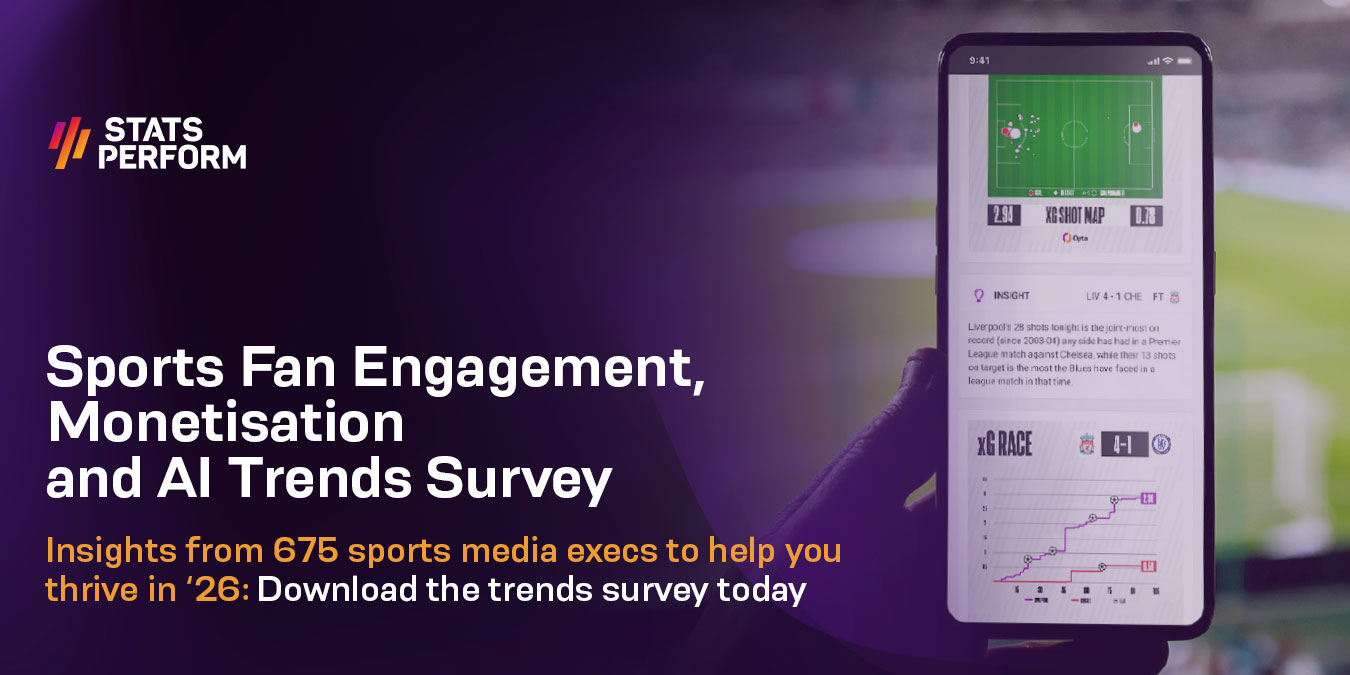
For more insights, data, and case studies from 675 sports-industry executives, download the full 2026 Sports Fan Engagement, Monetisation & AI Trends Report from Stats Perform: