
 Upgrade to Premium Now
The FBIN Management Excellence Summit 2025 brought together leaders from clubs, leagues, and technology partners across Europe to discuss the future of fan engagement, digital transformation, data, and organizational innovation. Across panels and presentations, a clear message emerged: football’s future belongs to those who combine creativity, data, and genuine connection with fans.
Below are the most important statements from the event.
Building Digital Fan Experiences With Authenticity
Wieland Schwarze of FSV Mainz 05 emphasized the club’s collaborative approach to digital transformation and fan culture:
“We follow the concept that we don’t just build for our fans – we build with them. We deeply involve them throughout the process, from collaborative testing to digital development.”
“We don’t see digitization as something that replaces the great fan culture we have in Germany. Instead, we see it as a way to enhance and evolve it through meaningful digital assets and a truly hyper-personalized fan experience.”
Clubs also explored how new digital platforms can shape engagement. Rui Xavier of Vitória SC stated:
“Our objective is to create a new platform capable of attracting and engaging fans in the club’s daily life.”
“We need to give the fans space to enter and connect to the club, and inside that space, they will keep building, engaging, and being part of their daily life.”
Data as a Foundation for Growth
Data was a central theme of the Summit, with speakers highlighting both its strategic value and its operational challenges.
Richard Beníšek of Enigoo stressed how even simple transactions matter:
“F&B transactions are not just about revenue. They are data. Thanks to tokenization, we know what the fan buys and when.”
In the panel on unlocking opportunities through data, Thomas Rypens of Club Brugge highlighted shifting assumptions:
“While everyone talks about Gen Z and Gen Alpha, our data shows the most loyal fans are 50 plus – the ones who always show up, no matter what.”
“An additional revenue stream that will grow in the coming years is the membership offering – reaching the millions of fans watching from their sofas.”
Mate Naletilić of GNK Dinamo Zagreb added:
“In the future, payment systems can help clubs access data, as every club has a huge emotional fan base that can be leveraged in a scalable way.”
Data structure and identity management were also key issues. As Arenametrix’s Nikolas Hachmann summarized:
“Building the right data structure may not be the most attractive part, but it’s what makes the entire digital strategy work.”
From Vision to Execution: Digital Strategy in Practice
Many speakers warned against innovation without execution. Alper Can of KRC Genk captured this tension:
“It’s great to have vision and ideas, but without tangible outcomes, they’ll remain just concepts.”
“A single sign-on account shouldn’t just be a login and password – it should unlock real value and exclusive experiences.”
Sevilla FC’s José Ángel Risco reinforced the importance of owning fan relationships:
“We saw an increasing international fan base and wanted to be closer to them – something we couldn’t achieve with traditional TV, which is why we develop our OTT platform.”
“Staying authentic while digitizing means being transparent, listening to fans, and adapting our policies as their expectations evolve.”
Lara Weber of FC St. Pauli expressed a similar need for independence:
“It’s becoming more and more important for us to be independent from social media platforms and build our own databases to reach and engage fans directly.”
Jan-Georg Streletzki of Unidy summed it up with a key KPI:
“One KPI we like to challenge clubs with is the ratio between your biggest social media channel and your own database. The goal should always be to have 100% of your social media reach in your own database.”
From Data to Content — and From Content to Revenue
Turning insights into revenue-generating content was another major focus. Markus Klausmann of Stats Perform explained:
“We collect the data, help you transform it into content, and then sell it in a smart way – turning insights into stories, and stories into revenue.”
“What impressed me most wasn’t the data or technology – it was the creativity. Our insight editors didn’t just visualize data; they branded it, repurposed it, and found sponsors who saw value in it.”
A broadcast perspective came from Marcin Serafin of Ekstraklasa Live Park:
“Predictive metrics have added a new dimension to our matchday storytelling. Displaying Live Win Probability during broadcasts adds a narrative element.”

Leadership, Trust, and Long-Term Club Building
The human side of club management was powerfully expressed by Tan Kesler of Pogoń Szczecin:
“The first step was simple but crucial – we had to restore trust. Pay the players, settle the vendors, and rebuild the belief that this club could stand tall again.”
“Rebuilding a club isn’t about quick fixes or revolutions. It’s about evolving, step by step, with honesty and patience.”
Innovation, Infrastructure, and the Future of the Matchday
Infrastructure experts highlighted that the stadium experience of the future extends far beyond 90 minutes. Jens Leonhäuser of Steilpass noted:
“There’s no written law that a football match must be over after two and a half hours. Extend the experience – there’s still so much potential to improve, to engage fans longer, and to earn more.”
Charlie Fordham of Populous emphasized the role of public space:
“Stadium design today isn’t just about what happens inside – it’s about creating open public spaces that bring people in, even on non-match days.”
And FC Blau Weiss Linz’ Patrick Vormair highlighted the strategic role of infrastructure:
“A stadium is not the end goal; it’s a platform to redefine your strategy and strengthen your community.”
Innovation leaders also explored what makes transformation successful. Thomas Rypens of Club Brugge stated:
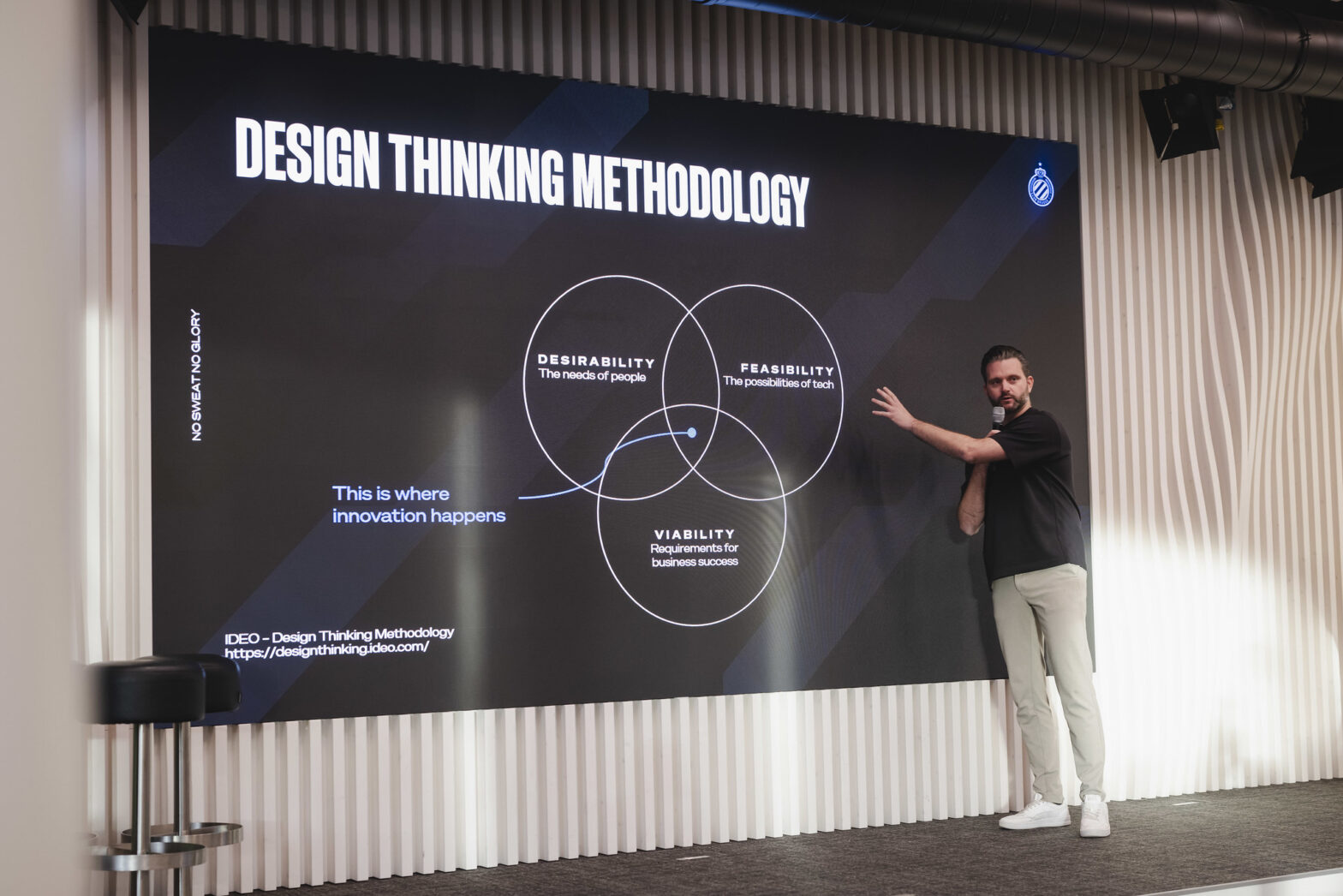
“Football clubs are performance organizations, just like Formula 1 teams. You can’t aim for podiums without a pit wall, without live data, without strategy.”
“AI is somewhere on the feasibility side, because it’s a question of technology. But the real question is, what is the desirability of AI? What do people actually want to get done with it?”
Dirk Schlünz of FC Nürnberg added two key principles:
“Creativity without execution is just a dream. But execution without creativity is routine – and that’s where many football clubs get stuck.”
“Innovation isn’t only about making things more economical or efficient. It’s about creating something people emotionally connect with.”
Stakeholder Management: Success Through Relationships
Finally, speakers emphasized that even in a digital age, football remains a people-driven business. Bálint Máté of Ferencvárosi TC said:
“Technology helps, but success still depends on building relationships – meeting people, talking to them, and involving them in your programs.”
Ane Arregi of Real Sociedad added:
“For us, success abroad isn’t about size – it’s about finding good partners who share our values and make the project meaningful.”